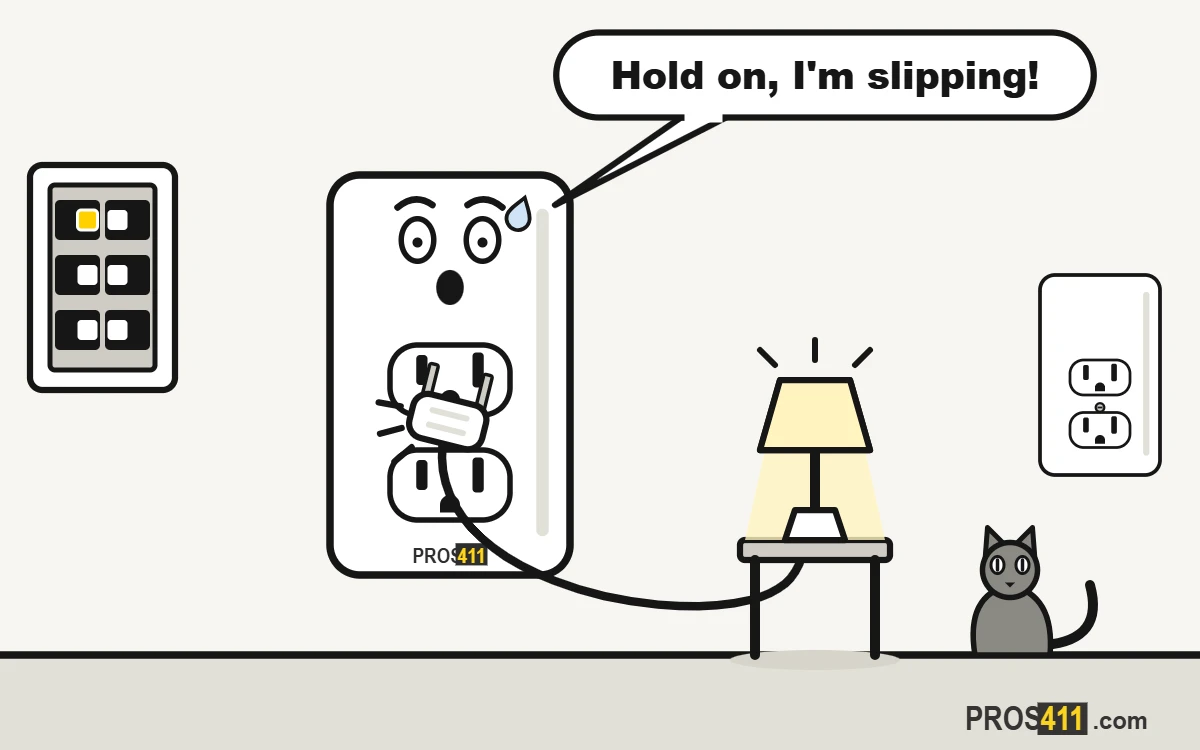
Short answer
If plugs fall out of an outlet, try the same plug in another outlet. If it holds there, the outlet's grips are worn out. If it is loose everywhere, check the prongs: bent or blackened prongs mean a new cord or device. A loose fit can heat up, so if the plug or cover feels warm, switch off the breaker. Have an electrician replace the worn outlet; do not tape the plug in.
Safety first
A loose plug can overheat. If the plug, cord or cover feels warm, or you see brown marks, switch off the breaker before you unplug. Do not bend the prongs, tape the plug in or open the outlet.
What to do when plugs fall out of the outlet
1The plug droops or falls out
The metal grips inside an outlet wear out and stop holding the prongs. A loose fit can also heat up.
Read all the steps
- The plug droops or falls out. The metal grips inside an outlet wear out and stop holding the prongs. A loose fit can also heat up.
- Try the plug in another outlet. If it holds firmly there, the first outlet is worn. If it is loose everywhere, the plug or its prongs are the problem.
- Check the prongs. They should be straight, firm and clean. Bent, loose or blackened prongs mean a new cord or device. Do not bend them apart to make them grip.
- Warm or marked? Breaker off. If the plug or the cover feels warm, or you see brown marks, switch off that breaker from a dry floor, then unplug.
- Have the worn outlet replaced. Do not tape the plug in or wedge it. An electrician can replace a worn outlet quickly, often with a tamper-resistant one.
- Still not fixed? Call an electrician Especially if: plugs fall out of one outlet but hold in others.
Electricians near you
Share your location and we will show the nearest ones with their phone number.
Or pick your city:
Why outlets get loose
Every time you plug in and pull out, the metal grips inside the outlet stretch a little. After years of use, or with heavy plugs like chargers and adapters, they stop holding. A loose grip means less contact, and less contact means heat. That is why a worn outlet is a fire risk, not just an annoyance.
What not to do
- Do not bend the prongs apart: they can break inside the outlet or overheat.
- Do not tape the plug in or prop it up with something.
- Do not hang heavy adapters or power strips from a loose outlet.
- Do not take off the cover to tighten anything yourself.
When to call an electrician
- Plugs fall out of one outlet but hold in others.
- The plug, cord or cover feels warm.
- You see brown marks, melted plastic or a cracked cover.
- Lights flicker or the device cuts in and out when you touch the plug.
Frequently asked questions
Why do plugs fall out of my outlet?
The metal grips inside the outlet are worn and no longer hold the prongs. It is common in old outlets and ones that get used a lot. An electrician can replace it.
Is a loose outlet dangerous?
It can be. A loose fit means poor contact, and poor contact heats up. If the plug or the cover feels warm or has marks, switch off the breaker and call an electrician.
Can I bend the prongs to make a plug fit tighter?
Better not. Bent prongs can break, crack the outlet or overheat. Replace the worn outlet instead.
Can a loose outlet cause a fire?
Yes, it can. Poor contact makes heat, and heat can melt the outlet and the wires behind it. Stop using it and have it replaced.
Why are new outlets so hard to plug into?
Many new outlets are tamper-resistant: shutters inside the slots keep kids from pushing things in. Push both prongs in at the same time, straight and firm.
Who replaces a worn outlet?
An electrician. It means working on the wires behind the cover, and they can check for heat damage at the same time.