Short answer
To patch a hole in drywall up to about 4 inches, look inside with a flashlight first for wires or pipes. Trim loose paper, stick a self-adhesive mesh patch over the hole and spread thin coats of joint compound, each one wider than the last. Let it dry, sand it smooth, prime and paint. Bigger than a fist? Cut a clean square, but only after you check behind the wall.
Safety first
Wires and pipes run inside walls, often straight up and down from outlets and switches. Look before you cut, cut shallow, and switch off the breaker for any outlet or switch near the hole. In a home built before 1978, the paint may contain lead: do not dry-sand old paint.
How to patch a hole in drywall
1Up to 4 inches? A patch kit does it
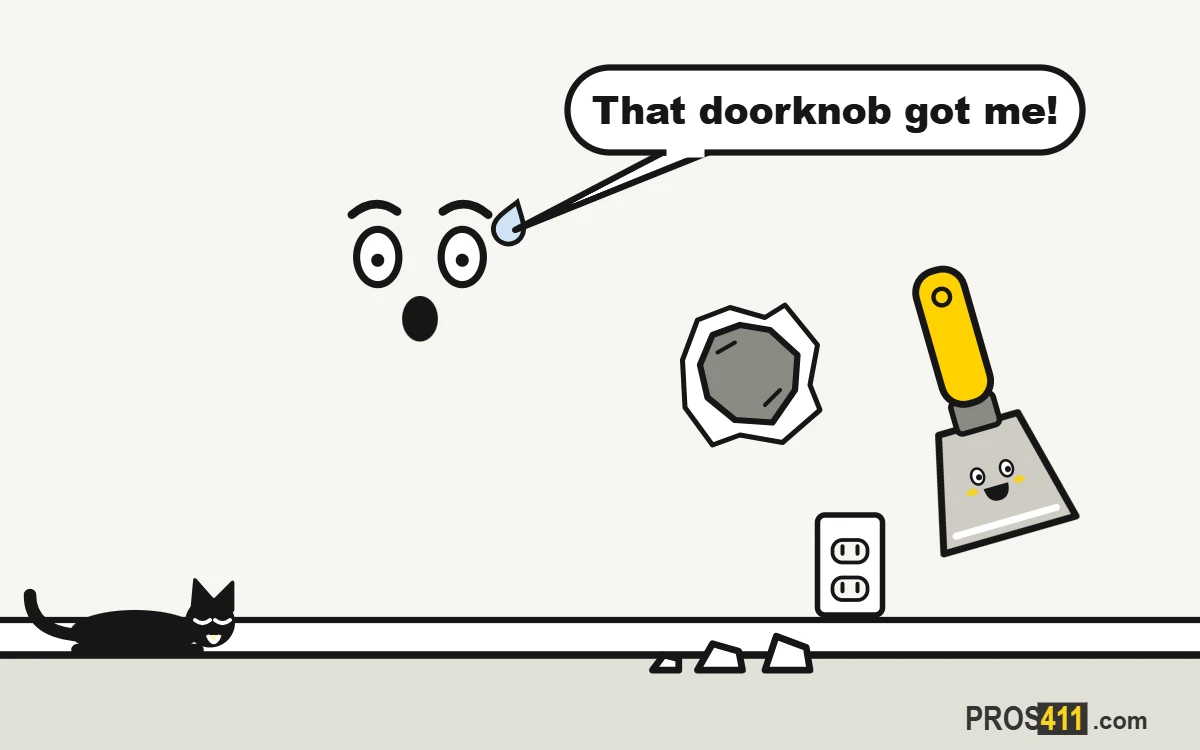
A doorknob hole is the classic. You need a self-adhesive mesh patch, joint compound, a putty knife and a sanding sponge.
Read all the steps
- Up to 4 inches? A patch kit does it. A doorknob hole is the classic. You need a self-adhesive mesh patch, joint compound, a putty knife and a sanding sponge.
- Look inside with a flashlight first. Wires and pipes often run straight up and down from outlets. If you see one, keep tools away from it. Never cut into a wall blind.
- Trim the edges and stick on the patch. Cut off torn paper with a utility knife so the patch sits flat. Center the mesh patch over the hole and press it down firmly.
- Spread thin coats of joint compound. Cover the patch with a thin coat and feather the edges a few inches past it. Let it dry, then add a second, wider coat.
- Sand smooth, prime and paint. Sand lightly with a damp sanding sponge until you cannot feel the edge. Prime the patch first, or the paint will look dull there.
- Still not fixed? Call a handyman Especially if: the hole is next to an outlet, a switch or a pipe, or you saw wires inside.
Handyman near you
Share your location and we will show the nearest ones with their phone number.
Or pick your city:
Bigger than a fist: cut in a new piece
- 1
Shine a light inside and switch off the breaker for any outlet or switch nearby.
- 2
Draw a square around the hole and cut it with a drywall saw, in short, shallow strokes, away from anything you saw inside.
- 3
Screw a strip of wood inside the opening, behind the top and bottom edges, as backing.
- 4
Cut a piece of drywall the same size and thickness, screw it to the strips, then tape the seams and finish it like the small patch.
What not to do
- Do not fill it with one thick coat. It cracks, shrinks and takes days to dry. Thin coats win.
- Do not saw into a wall without looking first, or straight above or below an outlet or switch.
- Do not dry-sand old paint in a home built before 1978. Use a damp sponge, or hire a pro certified in lead-safe work.
- Do not paint bare compound without primer: the patch will show through.
So it does not happen again
Put a door stop on the baseboard or on the hinge of the door that made the hole.
When to call a handyman
- The hole is next to an outlet, a switch or a pipe, or you saw wires inside.
- The drywall is wet, soft or stained: the leak has to be found and fixed first.
- The hole is bigger than about a foot, or there are many of them.
- It is on the ceiling.
Frequently asked questions
Can I patch a hole in drywall myself?
Yes, if it is up to about 4 inches across. A mesh patch kit, joint compound, a putty knife and a sanding sponge are all you need. Bigger holes need a new piece of drywall screwed to wood backing.
What do you use to fill a hole in drywall?
Spackle for nail and screw holes, and joint compound over a mesh patch for bigger ones. Lightweight spackle dries fast and is fine for small dents.
How long does joint compound take to dry?
Usually about a day per coat, longer in humid weather or with thick coats. Setting-type compound, the powder you mix with water, hardens in the time printed on the bag.
How do I know if there are wires behind the wall?
Look inside the hole with a flashlight, and assume wires run straight up or down from every outlet and switch. A stud finder with a wire setting helps. When in doubt, switch off the breaker before you cut.
Do I need to prime a drywall patch before painting?
Yes. Bare compound soaks up paint differently, so the patch looks dull or shiny. A coat of primer makes it blend in.
How do I stop a doorknob from making a hole again?
Install a door stop: a spring stop on the baseboard or one that clips onto the hinge pin. A small rubber bumper on the wall where the knob hits also works.
Sources
Checked October 24, 2026. Requirements and recommendations change: confirm them on the source site.