Short answer
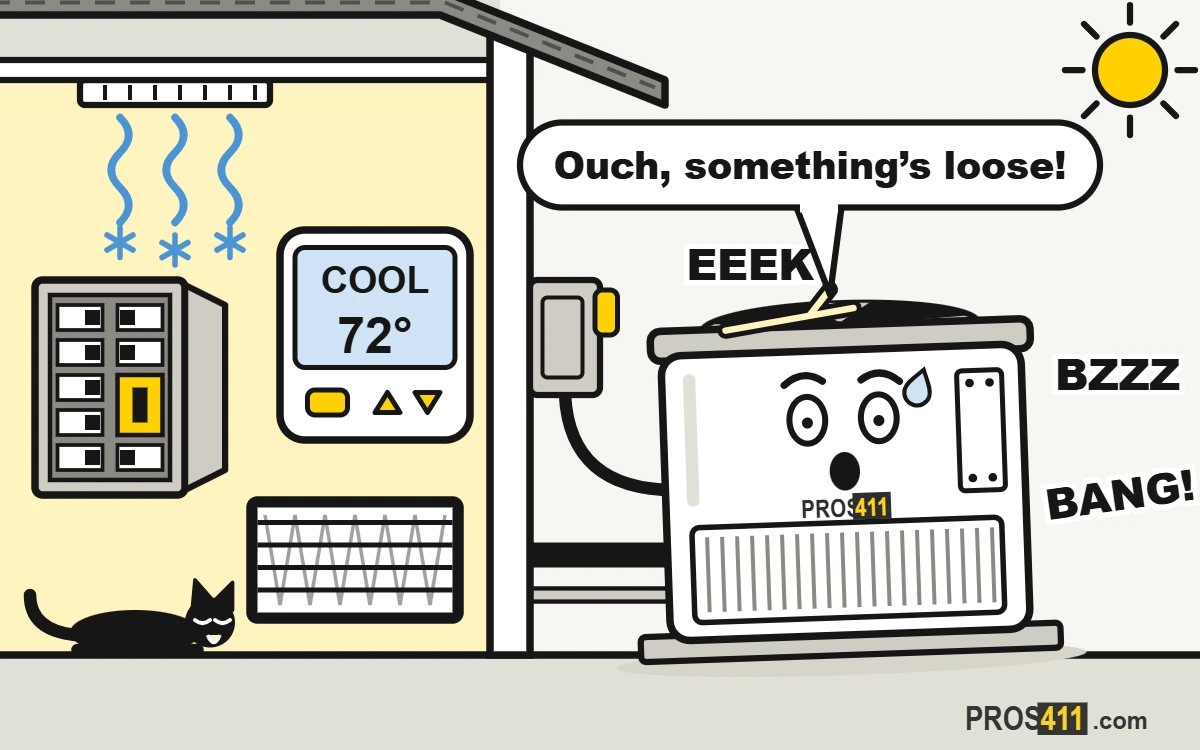
Turn the AC off at the thermostat if the noise is loud or new, so a loose part does not do more damage. Buzzing usually points to an electrical part, banging or clanking to a loose or broken part, and squealing to a fan motor or belt. With the power off at the disconnect box, lift sticks and leaves off the top of the outdoor unit. If the noise comes back, call a technician.
Safety first
Never reach into the fan or open the panels of the outdoor unit: parts inside can hold an electrical charge even with the power off. Switch the disconnect box to "Off" before you clear anything from the unit.
What to do when your AC makes a loud noise
1A new, loud noise
Buzzing, banging, squealing or rattling from the outdoor unit. A new noise means something changed, so act early.
Read all the steps
- A new, loud noise. Buzzing, banging, squealing or rattling from the outdoor unit. A new noise means something changed, so act early.
- Turn it off at the thermostat. Set it to "Off" so a loose part does not break more. Remember how it sounded so you can describe it.
- What the sound tells you. Buzzing: usually an electrical part. Banging or clanking: a loose or broken part. Squealing: a fan motor or belt. Hissing: a possible refrigerant leak.
- Power off, lift debris off the top. Switch the disconnect box to "Off". Lift sticks and leaves off the top grille. Never reach inside the fan.
- Power on and listen. Turn the disconnect back on and set the thermostat to "Cool". A rattle from a stick may be gone. Buzzing or banging again? Leave it off and call.
- Still not fixed? Call an HVAC contractor Especially if: buzzing, banging or screeching comes back after you clear the top of the unit.
AC & heating near you
Share your location and we will show the nearest ones with their phone number.
Or pick your city:
Sounds and what they usually mean
- Buzzing or humming with the fan stopped: often a failed capacitor or contactor.
- Banging or clanking: a loose or broken part, like a fan blade or a part inside the compressor.
- Squealing or screeching: a worn fan motor bearing, or a belt on some older indoor units.
- Rattling: loose screws or panels, or debris in the unit.
- Hissing or bubbling: a possible refrigerant leak.
- A click when it starts or stops is normal. Constant clicking is not.
What not to do
- Do not push a stick or a screwdriver into the fan to stop a noise or to get it spinning.
- Do not open the outdoor unit. The capacitor inside can hold a charge even with the power off.
- Do not keep running an AC that bangs or screeches. A small repair can turn into a new compressor.
When to call an HVAC technician
- Buzzing, banging or screeching comes back after you clear the top of the unit.
- It hums but the fan does not spin.
- You hear hissing or bubbling near the lines.
- The unit shakes, or you smell burning.
Frequently asked questions
Why is my AC making a loud buzzing noise?
Buzzing usually comes from an electrical part, like a failing capacitor, a contactor or a loose wire. Turn it off and call a technician, since those parts can hold a charge.
Why is my AC making a banging noise?
Banging or clanking usually means a loose or broken part, such as a fan blade or a part inside the compressor. Turn it off right away to avoid more damage.
Why is my AC squealing?
Squealing often comes from a worn fan motor bearing or, on some indoor units, a belt. A technician can replace the motor or the belt before it fails.
Is it normal for an AC to make noise?
A steady hum from the fan and compressor and a click when it starts or stops are normal. New loud noises, rattles or squeals are not.
Should I turn off my AC if it is making a loud noise?
Yes. Set the thermostat to "Off" and call a technician, especially for banging, screeching or buzzing. Running it can make the damage worse.