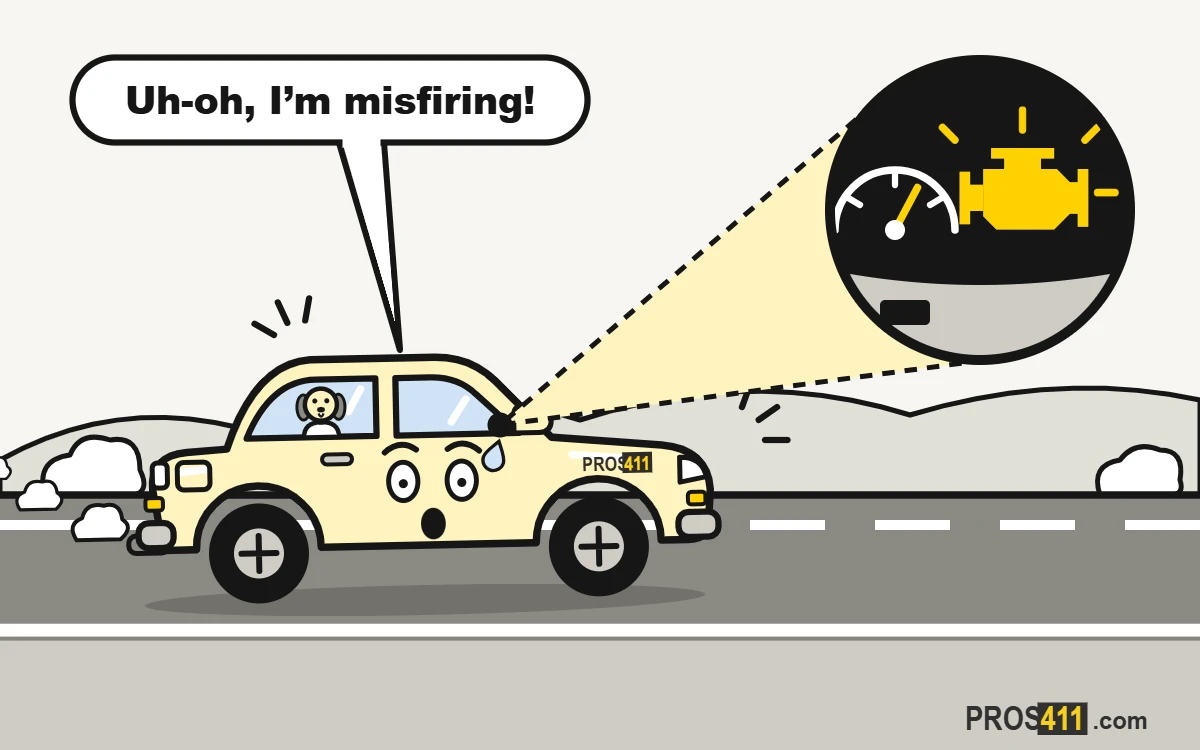
Short answer
If your check engine light is flashing, ease off the gas and pull over as soon as it is safe. The engine is misfiring (not burning fuel evenly), and driving on can ruin the catalytic converter, an expensive part. Turn on your hazard lights, turn the engine off and call a tow or a mobile mechanic. A steady light is less urgent: drive gently and get the code read in the next few days.
Safety first
Stop driving if the temperature gauge is in the red, the oil pressure light is on, or you smell burning or see smoke. Pull over where it is safe and turn the engine off. On a highway, pull as far off the road as you can, turn on your hazard lights and stay away from traffic.
What to do when the check engine light flashes
1The light flashes and the car shakes
A flashing check engine light means the engine is misfiring: it is not burning fuel evenly. You may feel shaking, jerking or a loss of power.
Read all the steps
- The light flashes and the car shakes. A flashing check engine light means the engine is misfiring: it is not burning fuel evenly. You may feel shaking, jerking or a loss of power.
- Ease off the gas and pull over safely. No hard acceleration. Turn on your hazard lights and stop in a parking lot or well off the road, away from traffic.
- Flashing and shaking? Do not drive far. Unburned fuel reaches the exhaust and can overheat the catalytic converter, an expensive part. Once you are stopped, turn the engine off.
- Check that the gas cap is tight. Turn it until it clicks. A loose cap turns on a steady light, not a flashing one, but it takes a second to rule out.
- Steady light: get the code read soon. A steady light is less urgent. Drive gently and have the code read by a mechanic or at an auto parts store in the next few days.
- Call a mechanic or a tow Especially if: the light is flashing (do not wait).
Mechanics near you
Share your location and we will show the nearest ones with their phone number.
Or pick your city:
What not to do
- Do not keep driving to "get home" with the light flashing: every mile with a misfire heats up the catalytic converter.
- Do not clear the code with a scanner and keep going. The light comes back and the damage continues.
- Do not wait on a narrow highway shoulder if an exit or a parking lot is close: get off the road first.
- Do not tow a trailer, climb steep hills or run the air conditioning until it is checked: extra load makes the misfire worse.
Common causes
Most misfires come from a worn spark plug or a bad ignition coil, the part that sends the spark to the plug. A clogged or leaking fuel injector, or air sneaking in through a cracked hose (a vacuum leak), can also cause one. A mechanic reads the stored code with a scanner and tests the cylinder that is misfiring. Tell them the light was flashing and whether the car was shaking, losing power or smelling of fuel. A mobile mechanic can do many of these repairs in your driveway.
When to call a mechanic
- The light is flashing (do not wait).
- The car shakes, loses power or smells of fuel.
- The temperature or oil pressure warning is on.
- A steady light stays on after you tightened the gas cap and drove a day or two.
Frequently asked questions
How long can I drive with a flashing check engine light?
Only as far as it takes to stop somewhere safe: treat it as an emergency. An active misfire can destroy the catalytic converter in a short time. Use the "24/7 emergencies" filter on the list to find mechanics who answer now.
Why is my check engine light flashing and my car shaking?
That is a misfire: one or more cylinders are not burning fuel properly, so the engine runs unevenly. The usual causes are a worn spark plug, a bad ignition coil or a fuel injector problem.
Why does my check engine light flash and then stop?
The engine is probably misfiring only under load, like when you speed up or climb a hill. When you ease off, the light stops flashing and stays steady. The problem is still there, so have it checked before you drive normally again.
Can a loose gas cap make the check engine light flash?
No. A loose gas cap usually turns on a steady light. A flashing light means a misfire.
Should I call a tow truck or a mobile mechanic?
If the car runs rough or other warning lights are on, a tow is safer. If it is parked safely at home, a mobile mechanic can read the code and often fix plugs, coils or sensors on site.
Will an auto parts store read my check engine code?
Many offer a free code read. The code tells you which system or cylinder has the problem, not always which part failed, so a mechanic should still test it.