Short answer
A clunk over bumps usually comes from a worn suspension part: a sway bar link, a shock or strut mount, a ball joint or a bushing. First empty the trunk of anything loose. Then do the bounce test and look for an oily, wet shock. Have it checked soon. If the steering feels loose or a wheel wobbles, do not drive: call a tow.
Safety first
Do the checks parked on level ground with the parking brake set, never under a car held up only by a jack. A worn ball joint can let a wheel fold under the car: if the steering feels loose, the car wanders or a wheel looks tilted, do not drive it.
What to check when your car clunks over bumps
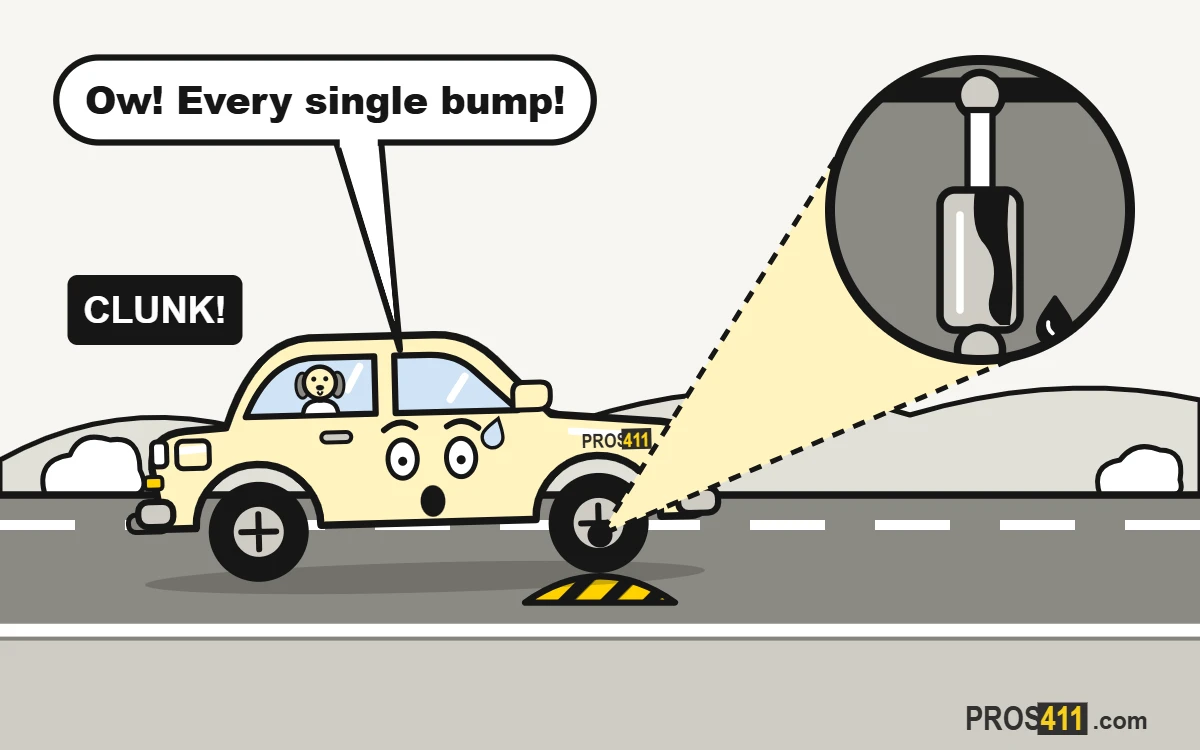
1Clunk! Every time you hit a bump
A knock from under the car over speed bumps, potholes or driveways. Notice if it comes from the front or the back, and if it also happens in turns.
Read all the steps
- Clunk! Every time you hit a bump. A knock from under the car over speed bumps, potholes or driveways. Notice if it comes from the front or the back, and if it also happens in turns.
- The bounce test: push down hard. Parked, push down hard on each corner and let go. A good shock settles after one bounce. If that corner keeps bouncing, the shock is worn.
- An oily, wet shock? It is worn. Look behind each wheel with a flashlight. A shock covered in oily grime is leaking and no longer controls the bounce.
- Loose steering or a wobbly wheel? Stop. If the steering feels loose, the car wanders or a wheel looks tilted, do not drive it. Call a tow or a mobile mechanic.
- Fixed: smooth over bumps again. A mechanic lifts the car, finds the loose or worn part and replaces it. Links and bushings are often a quick fix.
- Still not fixed? Call a mechanic Especially if: the steering feels loose or the car wanders (do not drive).
Mechanics near you
Share your location and we will show the nearest ones with their phone number.
Or pick your city:
Common causes
- Sway bar links: a light clunk over small bumps, often on one side.
- Shocks, struts or their mounts: knocking over bumps, a bouncy ride and a nose dive when braking.
- Ball joints: a clunk over bumps and when turning. Serious: get it checked right away.
- Control arm bushings: clunks when braking, speeding up or over bumps.
- Not the suspension: a loose spare tire, a jack or a heat shield on the exhaust.
What to tell the mechanic
Say when it happens: small bumps or big ones, turning, braking or all the time. Say which corner it seems to come from and when it started, for example after a pothole. If you can, record the sound on your phone.
When to call a mechanic
- The steering feels loose or the car wanders (do not drive).
- A corner keeps bouncing in the bounce test, or a shock is wet with oil.
- The clunk gets louder or also happens when you turn or brake.
- The tires are wearing unevenly.
Frequently asked questions
What causes a clunking noise over bumps?
Most often a worn sway bar link, shock or strut mount, ball joint or bushing. Sometimes it is just something loose in the trunk or a loose heat shield.
Is it safe to drive with a clunking noise?
For a short trip to a shop, usually yes, if the steering feels normal. If the steering is loose, the car wanders or a wheel looks tilted, do not drive.
How do I know if my shocks are bad?
The car keeps bouncing after bumps, dives forward when you brake or leans a lot in turns. A shock covered in oily grime is leaking. Try the bounce test on each corner.
Can a bad ball joint cause a clunk?
Yes, often over bumps and when turning. A worn ball joint can fail and let the wheel fold under, so have it checked right away.
Why does my car clunk over bumps at low speed?
Low-speed bumps like driveways and speed bumps load the suspension slowly, which makes loose links and worn bushings knock. A mechanic can find the play with the car on a lift.