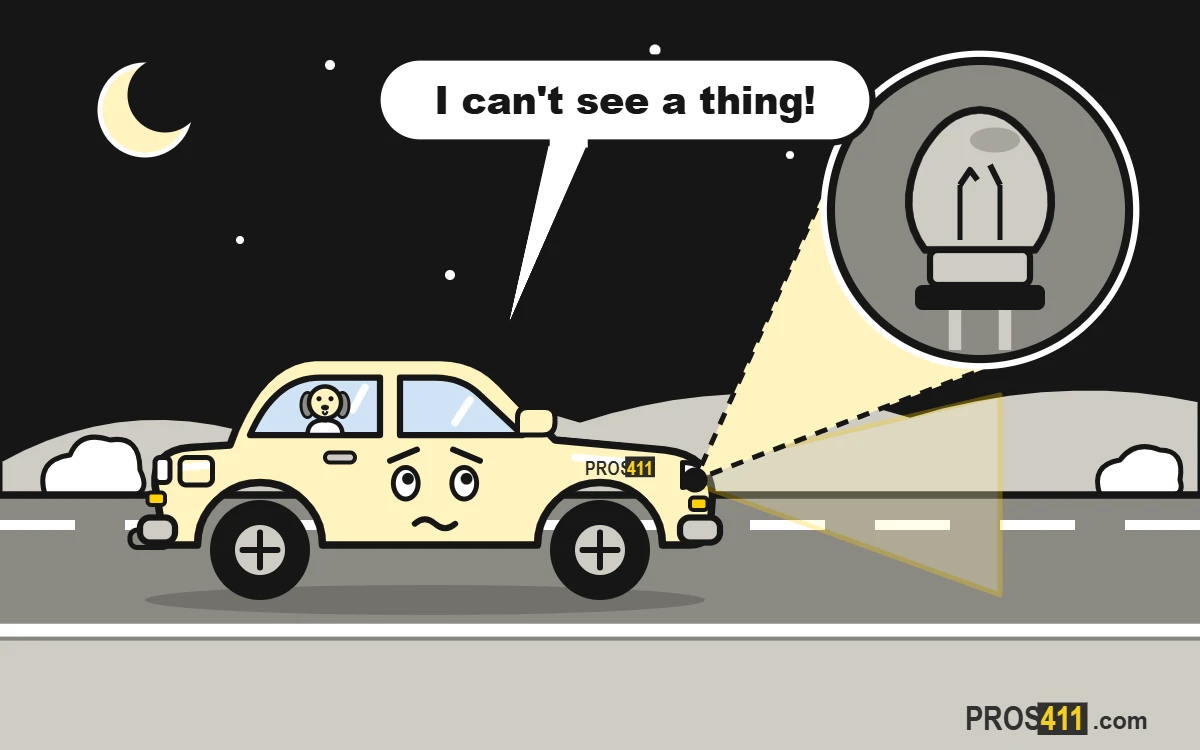
Short answer
If your headlights are dim or one is out, first check the light switch: headlights on, not just parking lights. One side out usually means a burned bulb. Both dim often means yellow, cloudy lenses that need cleaning. If the lights dim while you drive and the battery light comes on, the car is not charging: drive straight to a mechanic without turning the engine off.
Safety first
If you cannot see the road well at night, slow down and pull off somewhere safe and lit. HID (xenon) headlights run on very high voltage: leave those bulbs to a mechanic. Change any bulb with the lights and the engine off.
What to check when your headlights are dim
1The headlights look dim at night
The road ahead is hard to see, or one side is dark. Slow down and stop somewhere safe and lit to check.
Read all the steps
- The headlights look dim at night. The road ahead is hard to see, or one side is dark. Slow down and stop somewhere safe and lit to check.
- Pull over and check the headlight switch. Stop somewhere safe and lit. Turn the switch to the headlight setting, not parking lights, and try the high beams.
- One side out? Burned bulb. Park, turn the lights on and walk around the car. If one headlight is dark, its bulb is burned out. Replace both sides so they match.
- Both dim? Clean the cloudy lenses. Yellow, foggy plastic blocks a lot of light. A headlight restoration kit from an auto parts store clears it in about an hour.
- New bulb: hold it by the base. Many bulbs twist out from behind the headlight. Do not touch the glass of a halogen bulb with your fingers: skin oil shortens its life.
- Still not fixed? Call a mechanic Especially if: both headlights stopped working at the same time (often a fuse, relay or switch).
Mechanics near you
Share your location and we will show the nearest ones with their phone number.
Or pick your city:
When dim lights mean a charging problem
If the lights dim and brighten with engine speed, flicker, or dim together with the dash lights, the battery or the alternator may be failing. If the battery light comes on too, turn off everything you do not need and drive straight to a mechanic. Do not stop the engine on the way: it may not start again.
What not to do
- Do not drive at night with one headlight out: other drivers see you less, and you can get a ticket.
- Do not put in a brighter or different type of bulb than your manual lists.
- Do not open HID (xenon) headlights yourself: the high voltage can hurt you.
When to call a mechanic
- Both headlights stopped working at the same time (often a fuse, relay or switch).
- A new bulb did not fix it.
- The lights dim or flicker and the battery light is on.
- The bulb is only reachable by removing the bumper, or the car has HID or LED headlight units.
Frequently asked questions
Why are my headlights so dim?
Usually cloudy, yellow lenses or old bulbs that lost brightness. If they dim and flicker as you drive, the alternator or the battery may be weak.
Why is only one headlight out?
Almost always a burned-out bulb. Bulbs often fail one at a time, so replacing both keeps them even.
Can I change a headlight bulb myself?
In many cars, yes: the bulb twists out from behind the headlight in a few minutes. Some cars need the bumper or the wheel liner removed; your owner’s manual shows how.
Does cleaning cloudy headlights really help?
Yes. Clearing yellow, foggy lenses with a restoration kit can make a big difference at night. Finish with the UV coating that comes in the kit, or they fog again.
Can a bad alternator make headlights dim?
Yes. If the alternator is not charging well, the lights dim, flicker or brighten when you rev the engine. The battery light often comes on too.
Both headlights went out at once. Is it the bulbs?
Probably not: two bulbs rarely fail together. Check the headlight fuse and relay, or have a mechanic look at the switch and wiring.