Short answer
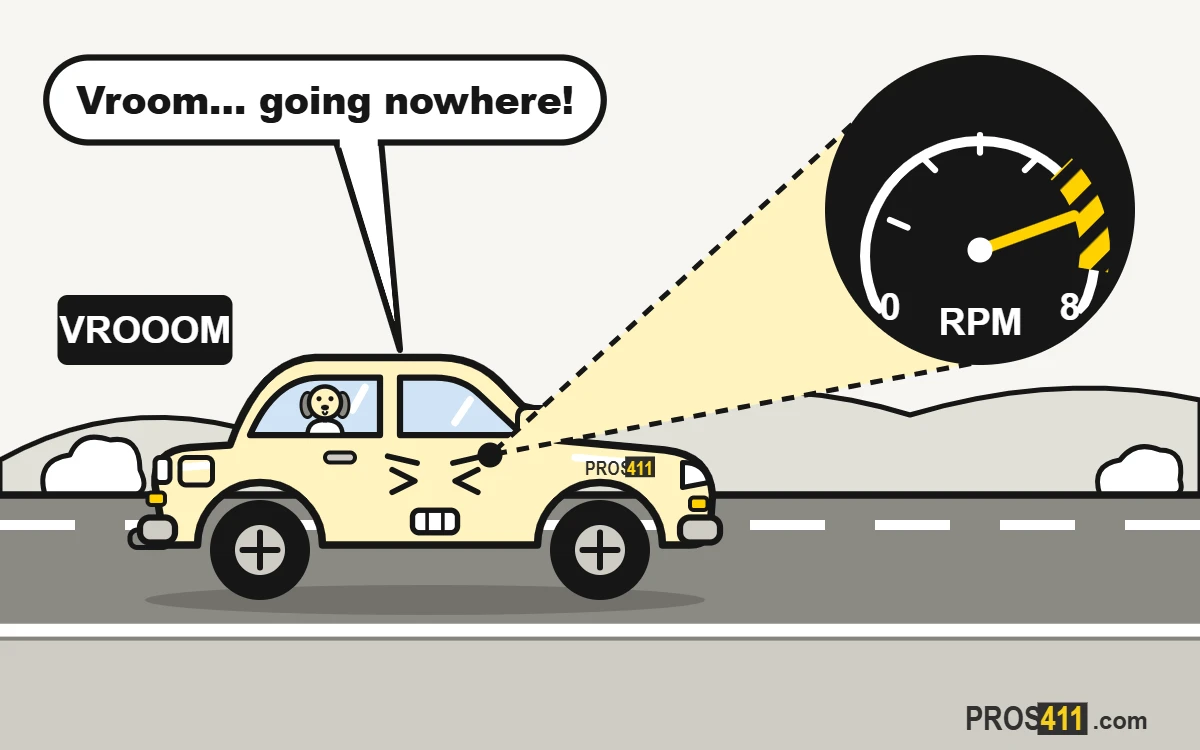
If the engine revs up but the car barely speeds up, or it shifts late and hard, the transmission is slipping. Drive gently and avoid hard acceleration. If your car has a transmission dipstick, check the fluid on level ground the way your manual says: low fluid or a burnt odor are common causes. Have it checked soon: driving on it turns a small repair into a big one.
Safety first
Check the fluid only as your owner’s manual says. Some cars need the engine running with the car in Park: set the parking brake and keep hands and clothing away from the belt and fan. If the car will not move or jerks hard in traffic, pull over and call a tow.
What to do when your transmission slips
1The engine revs, but the car barely moves
The RPM needle jumps while the speed stays the same, a shift comes late with a thump, or the car hesitates when you put it in Drive.
Read all the steps
- The engine revs, but the car barely moves. The RPM needle jumps while the speed stays the same, a shift comes late with a thump, or the car hesitates when you put it in Drive.
- Easy on the gas. Accelerate gently and avoid towing or steep hills. Hard driving heats the transmission and wears it faster.
- Check the fluid: low, or a burnt odor?. If your car has a transmission dipstick, check it the way your manual says. Low fluid, or fluid with a burnt odor that looks dark and gritty, needs a mechanic.
- An oily spot under the middle of the car?. Transmission fluid leaks show up under the middle or front of the car and feel oily. Slide white cardboard under it overnight to check.
- A shop finds the cause. A mechanic reads the codes, checks the fluid and any leak, and tests the shifting. Caught early, it can be a fluid service or a small part.
- Still not fixed? Call a mechanic Especially if: the engine revs without the car speeding up, even once.
Mechanics near you
Share your location and we will show the nearest ones with their phone number.
Or pick your city:
Signs of a slipping transmission
- The RPM climbs but the car does not speed up to match.
- A delay or a clunk when you shift into Drive or Reverse.
- Late, harsh or jumpy shifts.
- A burnt odor after driving.
- A transmission warning or the check engine light, or the car stuck in one gear.
Manual transmission? It may be the clutch
In a manual car, if the RPM jumps when you press the gas in a high gear but the car does not speed up, the clutch is slipping. You may notice an odor like burning paper. Do not rest your foot on the clutch pedal, and have the clutch checked soon.
What not to do
- Do not add the wrong fluid: each transmission takes a specific type, listed in your manual.
- Do not overfill: too much fluid foams and causes problems of its own.
- Do not keep driving hard hoping it goes away: slipping creates heat, and heat wears the transmission faster.
When to call a mechanic
- The engine revs without the car speeding up, even once.
- Shifts are late or harsh, or the car hesitates going into gear.
- The fluid is low, dark or has a burnt odor, or there is a leak.
- A transmission warning or the check engine light is on.
Frequently asked questions
What does a slipping transmission feel like?
The engine revs higher than normal but the car does not speed up to match, as if it slipped into neutral for a moment. You may also feel late or hard shifts.
Can low transmission fluid cause slipping?
Yes, it is one of the most common causes. Low fluid also means there is a leak, so have it found and fixed, not just topped up.
Can I drive with a slipping transmission?
Only gently and only to a shop. Every slip creates heat and wear. If the car will not move or jerks hard, call a tow.
Does every car have a transmission dipstick?
No. Many newer cars have sealed transmissions with no dipstick. In those, a mechanic checks the level with the car on a lift.
Will a fluid change fix a slipping transmission?
Sometimes, if the fluid was low or worn out and the slipping started recently. If parts inside are worn, it needs a repair. A mechanic can tell after checking the fluid and the codes.