Short answer
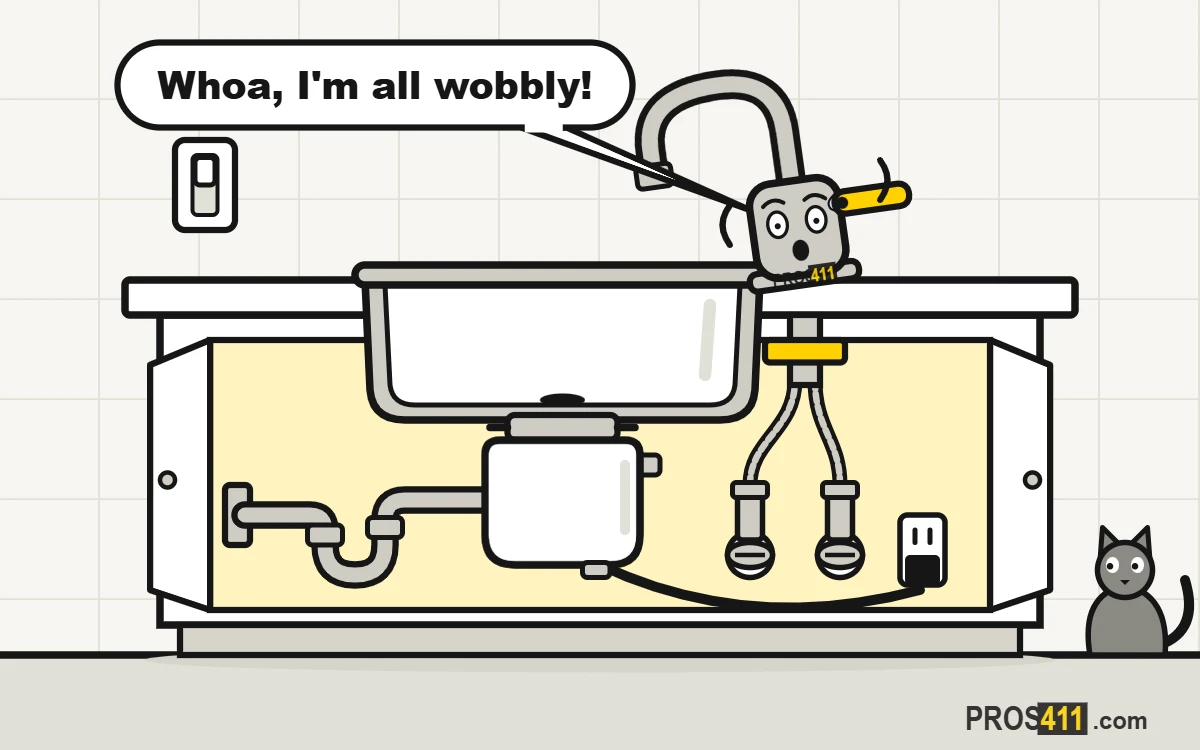
A wobbly kitchen faucet has a loose mounting nut under the sink. Empty the cabinet and find the nut with a flashlight, right under the faucet. Have someone hold the faucet straight from above. Snug the nut clockwise, as you look up at it, with a basin wrench or the tool that came with the faucet. Stop when it is firm: too much force can crack the sink or the counter.
How to tighten a loose kitchen faucet
1The faucet wobbles when you use it
Every push of the lever loosens it a little more. If you leave it, the hoses underneath twist and can start to leak.
Read all the steps
- The faucet wobbles when you use it. Every push of the lever loosens it a little more. If you leave it, the hoses underneath twist and can start to leak.
- Find the mounting nut with a flashlight. Empty the cabinet and look up behind the sink, right under the faucet. The big nut or bracket on the threaded rod holds it down.
- Have someone hold the faucet straight. From above, a helper keeps it centered and facing the right way while you work below.
- Snug the nut with a basin wrench. Its long handle reaches up behind the sink. Turn clockwise, as you look up at the nut, until it is firm.
- Solid again. Wiggle the faucet: it should not move. Run the water and check underneath for drips.
- Still not fixed? Call a plumber Especially if: the nut is corroded or will not turn.
Plumbers near you
Share your location and we will show the nearest ones with their phone number.
Or pick your city:
If only the handle is loose
If the faucet is firm but the lever wiggles, the set screw in the handle is loose. Look for it under a small cap or at the back of the handle, and tighten it with an Allen key or a small screwdriver. If the handle still slips, the cartridge stem may be worn.
What not to do
- Do not crank the nut as hard as you can. It can crack a porcelain sink or a stone counter.
- Do not twist the faucet to line it up after tightening. That twists the hoses underneath.
- Do not glue or caulk the base to stop the wobble. It comes loose again and traps water.
When to call a plumber
- The nut is corroded or will not turn.
- The mounting hardware or the threaded rod is broken.
- Water leaks at the base of the faucet or under the sink after tightening.
- The faucet is firm at the base but wobbles from inside its body.
Frequently asked questions
Why does my kitchen faucet keep getting loose?
Every pull on the lever works the mounting nut loose over time. A firm snug, with someone holding the faucet straight, fixes it for a long while.
What tool do I need to tighten a kitchen faucet?
A basin wrench, a long tool made to reach the nut behind the sink. Many newer faucets come with a plastic wrench, or with a nut you can turn by hand or with a screwdriver.
Do I need to turn off the water to tighten a faucet?
Not to tighten the mounting nut. Turn it off only if you need to disconnect the supply hoses or the faucet leaks.
Which way do I turn the nut to tighten it?
Clockwise as you look up at it from under the sink. If you are not sure, give it a quarter turn and wiggle the faucet to check.
Can a loose faucet cause a leak?
Yes. The constant movement strains the supply hoses and the seal at the base. Tighten it before water gets under the sink.