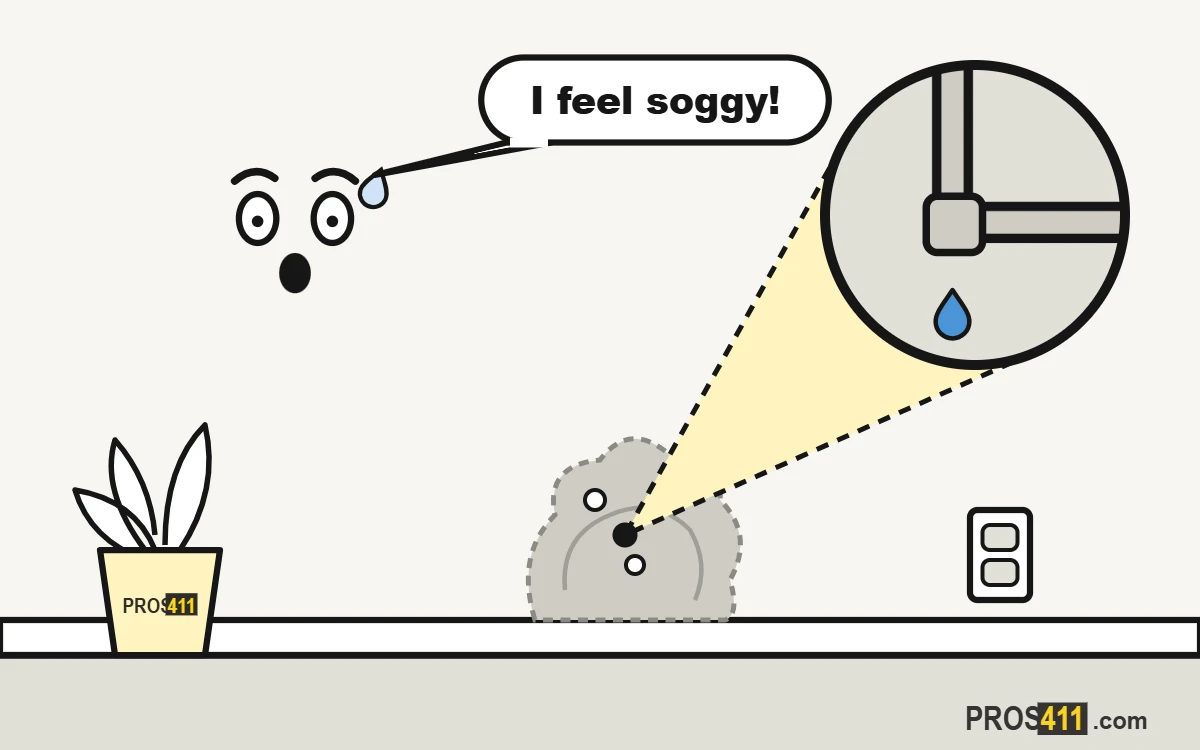
Short answer
Check what is behind or above the stain. A bathroom, kitchen, laundry or water heater points to a pipe; a stain that grows after rain points to the roof or a window. Turn off all water and check the meter: if it moves, something is leaking. A moisture meter shows how wet the wall is. Do not cut into the wall blind: call a plumber to find and fix it.
How to tell if a pipe is leaking inside the wall
1The stain keeps growing
A damp, dark patch near the floor or a corner, paint bubbling or soft drywall. Notice if it grows after showers, laundry or rain.
Read all the steps
- The stain keeps growing. A damp, dark patch near the floor or a corner, paint bubbling or soft drywall. Notice if it grows after showers, laundry or rain.
- Turn off all water and check the meter. With every faucet and appliance off, watch the leak indicator on the meter. If it spins, a supply pipe is leaking. Drain leaks only show while water runs.
- Measure it with a moisture meter. Press its pins against the stain and against a dry wall nearby. A much higher reading on the stain means water is still getting in.
- Behind the wall: a dripping pipe or fitting. Most wall leaks come from a fitting on a supply line, a drain joint or a shower valve. A plumber can confirm it with a thermal camera before opening anything.
- A small opening, a repair and drying. The plumber opens a small access hole at the right spot and fixes the pipe. Fans dry the wall before it is patched and painted.
- Wet wall? Call a plumber to find the leak Especially if: the stain grows, feels soft or the paint bubbles.
Plumbers near you
Share your location and we will show the nearest ones with their phone number.
Or pick your city:
A pipe, or something else?
- It grows after you shower or run the washer: a drain or the shower valve.
- It grows all the time, even at night: a supply pipe under pressure.
- It only grows after rain: the roof, a window or the siding.
- An outside wall in winter with no drip: it may be condensation.
What not to do
When to call a plumber
- The stain grows, feels soft or the paint bubbles.
- The meter moves with all the water turned off.
- You see mold, smell mildew or the baseboard is swelling.
- There is an outlet or a switch near the wet area (call an electrician too).
Frequently asked questions
How do I know if a pipe is leaking behind my wall?
Look for a growing stain, bubbling paint or soft drywall, then do the meter test with all the water off. A moisture meter reading that stays high also points to an active leak.
Can a water stain on the wall come from something other than a pipe?
Yes. Roof and window leaks, condensation on cold outside walls and splashing from a shower can all stain a wall. If it only shows up after rain, it is probably not the plumbing.
Is a leak in the wall an emergency?
Not usually, unless water is pouring out or it is near outlets. Shut off the water to that area if you can and call a plumber soon: slow leaks rot framing and grow mold.
How do plumbers find a leak inside a wall?
With moisture meters, thermal cameras and sometimes acoustic tools. That lets them open a small hole in the right spot instead of tearing out the wall.
Should I cut open the wall myself?
Better not. Wires and other pipes run inside walls, and a hole in the wrong place does not help. Let a plumber find the spot first.
Will the stain go away when the wall dries?
Usually not completely. Once the leak is fixed and the wall is dry, a stain-blocking primer and new paint cover it.